
Looking for something new to read? Maybe give these six Asian texts a whirl if you haven’t already.
January 2025 and, specifically, January 24th, marked the beginning of the Year of the Snake. As a New Year’s festivity, a representation of spring’s inauguration as per the lunisolar calendar. Which dated this particular occasion significantly within the Asian cultural context? The Asian literature, full of happy narratives, is a big bulk of storytelling. Let’s just begin collecting it with.
Crevasse is indeed a very alluring and exquisite piece of art. This might be my favorite collection of poetry for through the work Wong explores several identities that define the body: the queer body, the colonized body, and the ill body. ‘Postcolonial Zoology’ narrates the transfer of Hong Kong from Britain to China. But culture/ do you mean when Wall Street is flooded/ with debts and failed specimens of the Me-/ generation?” An author from Hong Kong—where Cantonese is his mother tongue skillfully navigates the language in which he writes and then challenges its users regarding their past. Out Wong has further been awarded the Hong Kong Young Artist Award in Literary Arts the Peter Porter Poetry Prize from the Australian Book Review and the Renaissance Foundation Prize in Literary Arts. Moreover Crevasse is the latest Lambda Literary Award for Gay Poetry winner for 2016 making it utterly mesmerizing at its core.
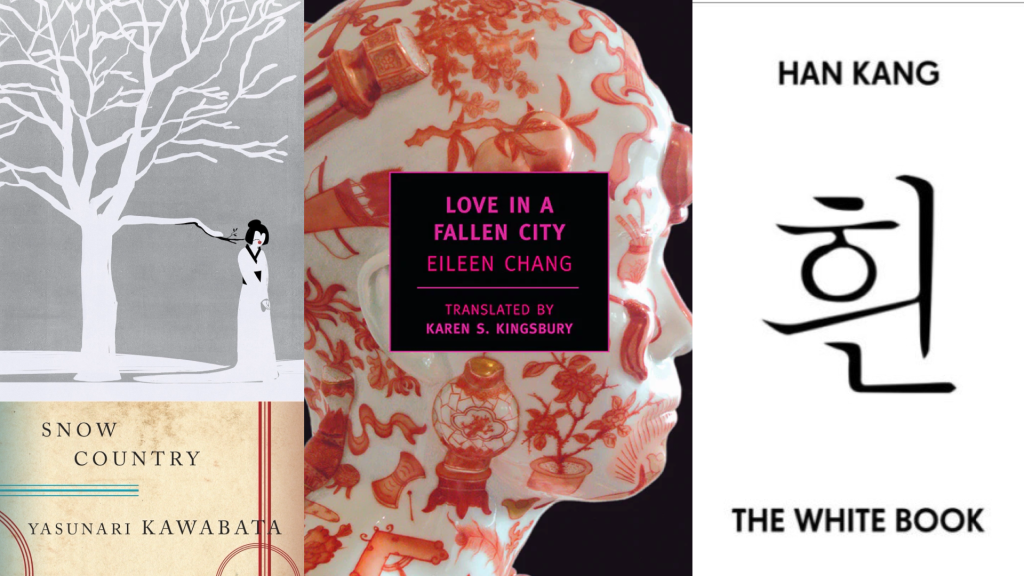
The biggest festival of the year in China is the Chinese New Year festival. I know I need to learn more about Chinese literature, and you might have heard of or read Rebecca Kuang’s brilliant book, Babel, or the Necessity of Violence. However, one of the standout books I read last year was Love in a Fallen City. It’s by Eileen Chang, a Chinese-American author writing during the Japanese occupation in Shanghai. She writes very evocatively about marriage, revolution, and love. It’s a bit like Romance of the Three Kingdoms, but much less tedious; it covers only a few years rather than three centuries of history. This novel covers the story of Bai Liusu, a young divorced woman from Shanghai, and Fan Liuyan, a notorious playboy from Hong Kong while initially being settled in Shanghai and later moved to Hong Kong in the late 1940s. The narrative threads the discomfort of widowhood in China the looming threat of violence in a nation under siege and the trials of Fan Liuyan's mixed British and Chinese heritage in the face of domestic unrest to produce a tapestry of social concerns that bind this book together. It is highly engrossing in its infusion of sorrow and passion.
In South Korea, the Lunar New Year is known as Seollal. For writing her tremendous and lyrical novel, The White Book, South Korean writer Han Kang got the 2024 Nobel Prize in Literature, and in 2016, Man Booker International prize for The Vegetarian. Unlike its predecessor, The White Book does not pretend to be a novel but rather an autobiographical reflection steeped in lament over themes of childhood, motherhood, birth, and death. It’s melancholy but also captivating with its expansion on the theme of the color white. The distillation of pain and joy is there as it mourns for Han’s mother and an infant sib before her. Unconventional and experimental with a distinct cryptic quality, even in translation by the exceptional Deborah Smith, this contemporary piece: Brevity in writing refers to: “Days wherein both darkness and light are imperfect swells with memories of the past. Of the future, memory’s mind cannot examine, only a memory. Before her now is amorphous light, flickering like some gas of unknown composition.”
Tết is the Vietnamese New Year, the new collection of Vuong, Time is a Mother builds on themes of intricate family dynamics explored in his celebrated debut novel, On Earth We're Briefly Gorgeous. Vuong's personal familial history is deeply interwoven with that of the Vietnam War and retold in his second collection, Time is a Mother. It also features renditions of his persona exploring the landscapes of Vietnamese American experience. Not to mention the character of being a gay Vietnamese immigrant, and dealing with his mother's death: ‘empty as a word / -less mind stop writing / about your mother they said / but I can never take out / the rose it blooms back as my own.’ While the weight of the themes is significant, moments of humor are present as well: “Can you believe my uncle worked at the Colt factory for fifteen years only to use a belt at the end? / Talk about discipline. Talk about good lord.” Vuong’s writing is both complex and succinct, moving beyond the painful journey of healing to a detailed narrative full of soul and hope.
The Membranes is a 1995 Taiwanese queer science fiction novel by Chi Ta-wei. It takes place in the twenty-second century, and its protagonist, Momo, practices dermatology in an Earth where human beings have long ago wrecked the ozone layer and otherwise battered the environment. They need more and more effective protection from ultraviolet radiation—at least on land—as a society moving into the ocean. Momo emerges as a key figure in spearheading this transition in a world wracked with epidemics of skin cancers. Chi Ta-wei’s remarkable flight of fancy, accessed through the able pen of translator Ari Larissa Heinrich, is to be on the top recommendation list of all students and professors.
While it is not a national holiday in Japan, the city of Yokohama will stage a 15-day Chinese Spring Festival. You may have stumbled upon works by Murakami and Kawaguchi, so let me introduce you to Snow Country, bleary and melancholy, focused on the affair between geisha Komako and a rich Tokyoite named Shimamura. This is not the book by Sebastian Faulks. Taking place in a hot spring village deep in the snow country, Kawabata Yasunari sets down an agonizing romance. Unlike city geisha, who are acceptable urban professionals, it's the geisha from Snow Country like Komako that meet with social rejection and are always compared to prostitutes. The novel, of course, also represents a critique of the polygamous male–dominated culture of 1930s Japan; to grossly satisfy male desires through the exploitation of women. This ends up being portrayed as tragic and ultimately futile, if it indeed can be termed as love in the first place. Caution: It might remind you of your last situationship.