
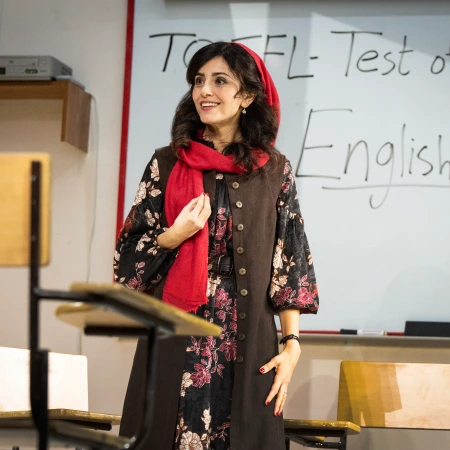
Through a large rectangular window, one can draw back the curtains to let in enchanting sounds of something distant and conscious. A glimpse is offered to us, serene and simple, into something unique, extraordinary, and subtly magnificent; this remarkable and introspective production of English, having made its way to Broadway after a successful engagement at the Atlantic Theater Company, now comes entering our view. Toossi (Wish You Were Here) playwright Sanaz has brilliantly woven an intricately developed narrative as a means to explore our frustrations and the profound human consequences that arise when trying to internalize a new language. The stories shared here resonate powerfully under the exceptional direction of Knud Adams (ATC's I'm Revolting), delving into themes of acceptance, belonging, and connection while discovering both humor and dignity within the challenging framework of a complex new language.
Like its consequences downtown, the co-production of English plays by the Roundabout/Atlantic Theater Company features a smart mixture of humor and sadness against a bare background that mirrors troubles of another world, made by Marsha Ginsberg (Barrow St.'s The Effect). This show has great costumes created by Enver Chakartash (Broadway's Stereophonic), with lights by Reza Behjat (Public's The Ally) and sound by Sinan Refik Zafar (Broadway's What the Constitution...). The play gets its strong spirit from its linked humor and many views, showing the actions in a plain classroom where four students meet in Karaj, a big part of Tehran, Iran, to get ready for the Test of English as a Foreign Language (TOEFL). But what happens here is not boring or usual. It is full of real human talks that hit home on many levels, much more than can be understood in one watching.
Running briskly for 115 minutes, the play considers the personal barriers four overly eager participants face in believing that passing this test will usher them into a different phase of their lives. Under the guidance of their teacher, Marjan, wonderfully nuanced and compassionate in her performance (from PH's Wish You Were Here), the students find engagement and conflict in the space of the classroom, each having different problems to work with. This especially happens when Marjan asks them to feel the vulnerability of speaking only in English during lessons. While it can be frustrating—and I know well from my own journey with learning French, Spanish, and Italian through college and private lessons—it drives the narrative forward within a compelling framework.
We are told that speaking English does not aspire to be poetry unlike Farsi which the characters sometimes embrace and aspire to. While the whole play is written in English, the shift to their primary language comes out in a remarkably graceful way. This very delicately put together and performed method points, in a subtle way, to the journey that expression and understanding have, with many layers of connection and disconnection emotionally.
When there are problems with English, the strong accents and nervous pauses are very noticeable. But when "Farsi is winning" and they go back to their first language, even though their teacher does not like it, their real selves shine through well. Among them, Elham is the most troubled person—she is a hopeful medical school applicant shown with strength by Tala Ashe (from PH's The Profane). It seems she cannot hold back; she must strike out at those around her to keep her place. Though she seems sharp and hard to like, Ashe gives such warmth to her character that we inevitably feel for her.
Another character who seems to have an inner life battling to stay as hidden as possible is the complex and rigid Roya, played with stoic elegance by the enchanting Pooya Mohseni. Her estranged son has moved to Canada, and the most evident need for her is to learn English, which would allow her the chance to see and connect with her granddaughter. The youngest, and by far the most empathetically involved, is the sharp Goli, beautifully portrayed by the very talented Ava Lalezarzadeh, who works hard to create ties with everyone as she seeks to construct a brighter future.
Another character who stands out is very intricately known plays his role in the class. The attractive Omid, played by the very talented Hadi Tabbal (from Vineyard's Russian Troll Farm), shows a much higher level of understanding and seems to hold some secret about why he is there. His playful interactions with the teacher have that very captivating charm reminiscent of a Hollywood romantic comedy, something that is artfully reflected in the film viewings aimed at absorbing the nuances of the English language. However, his true nature is elusive—until all comes to light.
Director Adams finds a beat and liveliness that strongly links all parts while illustrating the main ideas in this great five-star Broadway opening at the Todd Haimes Theatre of the Roundabout Theatre Company. The big problems about fitting in and culture are marked with real originality on the results of a pass or fail test looked at from different views, while personal secrets are shown clearly within those lessons. The folks, with their small details, share the thought with soft clarity, leading to a smart show and a deep play that might just be the best of the season. Every moment hits the mark, getting top scores from all sides through the careful showing of speech and ways͏.