
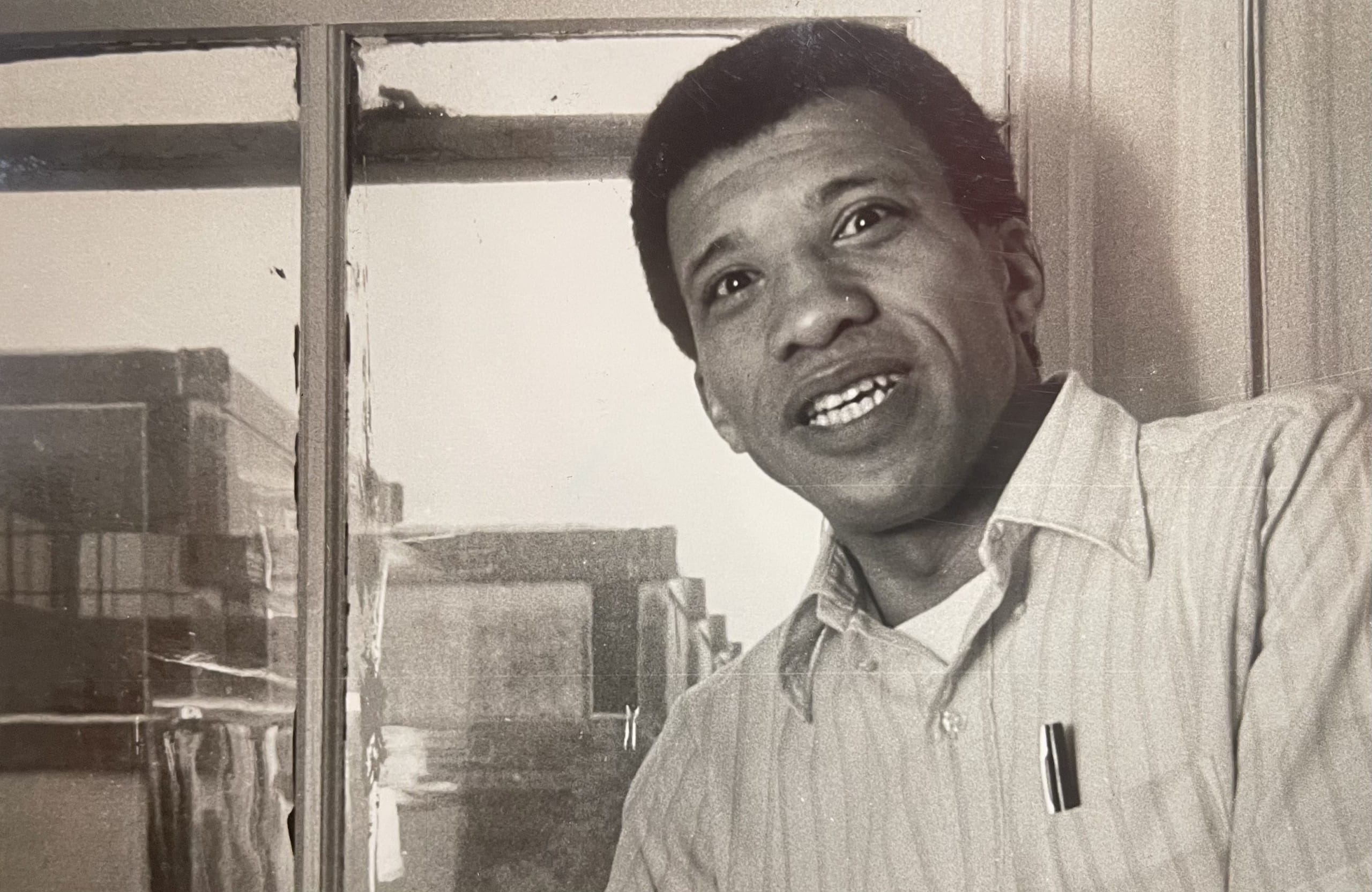
Editor's Note: Dr. Jerry Washington Ward Jr., died on February 8, 2025. He was a very devoted contributing writer for the Jackson Advocate. However, this viewpoint from author and poet C. Liegh McInnis serves best to honor a man who worked very unselfishly for the betterment of black communities. We in the Jackson Advocate family send our deep condolences to the Ward family.
Dr. Jerry Washington Ward Jr. emerged as perhaps one of the most outstanding literary personalities in Mississippi and far beyond, achieving excellence in such varied aspects of his work that very often led to his talents being overlooked and not receiving the proper credit they deserved. He was better than preferred poets among many, outshining most of their favored literary theorists, proved a superior editor compared to their favorite editors, was a more effective educator than those they admired, and served as a better mentor than many of their chosen guides—all while holding down some great moves on the dance floor with the electric slide.
His poems show the power of simple and bold pictures, while his essays point out that a literary critic's job is not to show off smarts or pride, but to help us see how creative works reflect the world we live in—its wins, flaws, oddities, and what it could be—working to teach us, fix us, and inspire us to better ourselves and our world.
Also, he was the main connection between the generations of Richard Wright and Margaret Walker Alexander and the present group of Mississippi writers, keeping up a standard of excellence in literature. As a co-founder of Callaloo along with Charles Rowell and Tom Dent — all three were professors at HBCUs — Doc Ward helped steer one of the three top black literary journals in the world to give voice to black writers while nurturing, illuminating, and enhancing black creativity. His most acknowledged contributions are the anthologies Trouble the Water: 250 Years of Black Poetry and Black Southern Voices, titles that he edited. But my own favorites are "Don't Be Fourteen (in Mississippi)" and "Jazz to Jackson to John," because they show wonderful pictures that clearly share the terrors of Mississippi's past while also honoring the smarts, courage, and grace of black folks' strength in facing hard times to make a brighter world.
"Don't Be Fourteen (in Mississippi)" is included in Dr. Howard Rambsy, master teacher, literary scholar, and Ward's student, important compilation of "77 Poems about Vulnerable Black Boys and Black Men," which he published as a tribute on Ward's birthday. Also, in my capacity as publisher and editor of Black Magnolias Literary Journal, I chose Doc Ward's poem, "Winter Solitude," to illustrate the kind of poetry we wanted to feature.
To fully appreciate his literary talent, I suggest you purchase a copy of Conversations with Jerry W. Ward, Jr., edited by Dr. John Zheng.
Surpassing all of these accolades, I would say there was no greater mentor or friend than Doc Ward. Invariably, I feel inadequate as a teacher compared to him and was constantly awed by his ability to guide such a diverse range of writers so targetedly and impactfully. His mentees received bespoke guidance rather than the off-the-shelf advice that befalls most young writers, and he always served up the hard truths we needed to hear rather than what we wanted to hear.
I have a million fond memories with Doc, but I’ll share two. One is the eighteen-line poem I gave him, which he marked with red slashes on all but two lines and wrote comments about why they didn’t work. Then he said, "These two aren't crap. Start there." A lot of people tell this story and focus on his choice of words. But very few, if any, ask about the comments that went with the lines. Those notes had some of the best details and smart reasons for why those lines didn’t work. Doc was direct, but his help was always positive. Far more crucial was the fact that he never sought to make his mentees a mini-version of himself; rather, he wanted us to be the best possible version of ourselves.
In 2001, I was nominated for the Tom Dent Award and became a finalist with my friend and talented poet Saddi Khali. When I found out that Brother Saddi won the award and and got to give the keynote address analyzing his work, I was pretty shocked. It seemed strange to me that someone who didn’t win would have to explain in public why the other person won. Of course, I got a little irked and told them I would consider it. Generally, when people say, "Let me get back to you," it's clear they won't follow up. A few days later, I was with Doc Ward and started telling him what had happened. He listened patiently while I talked about how weird it was. After letting me express my feelings, he asked, "C Liegh, is Saddi a good poet?" "Sure, Doc," I said. He asked, "Do you think he deserves the award?" "Yes," I said, but before I could explain, Doc urged me, "C Liegh, do the presentation for your friend, a skilled poet. After a moment of silence and seeing that I was still unsure, he said, "C Liegh, careers in literature are like God; they function in strange and mysterious ways." So I gave in and took the chance to do the keynote.
Here’s the interesting part; at that moment, the Tom Dent Award did not come with a cash prize. But right after my presentation and analysis of Brother Saddi's poetry, I was immediately offered four paid opportunities to speak about black poetry, and my work on Brother Saddi's poetry ended up getting published. Once more, Doc Ward gave me advice that I treasure to this day.
It was my privilege to present Doc Ward with the very first Reginald Martin Award for Excellence in Criticism during the 32nd Annual PEN Oakland-Josephine Miles Literary Awards, which happened virtually in 2021. My speech contained the following thoughts: No one deserves this first award more than Dr. Jerry W. Ward Jr. He was born in Washington, D.C. in 1943 and moved to Mississippi when he was six years old. He obtained his degree from Tougaloo College, where he earned a Bachelor of Science degree in 1964. Dr. Ward begins this narrative as a creative writer and theorist, developing poems and essays that articulate aesthetic and sociological appreciation for the genius, beauty, and strength of African peoples. His first national publications surfaced in the summer 1972 edition of Black Creation, the 1973 issue of Hoo-Doo, and a 1983 edition of Black Collegian. The pieces that came out in Hoo-Doo and Black Collegian created lasting friendships for Ward with Ahmos Zu-Bolton, the late poet and editor, and Kalamu ya Salaam, poet, fiction writer, playwright, editor, and activist. Along with Tom Dent, a playwright and activist in editing, these writers helped establish the base of Afro-Southern literature inside the legacies formed by Richard Wright and Margaret Walker Alexander.
By the early 1970s, he was associated with BLKARTSOUTH which emerged from the Free Southern Theater founded in New Orleans in 1964. This organization had among its purposes the promotion and honoring of black theater and the use of theater as a tool for social and political change. As a result, he often wrote for its journal Nkombo.
In November 1973, Ward became involved with the Southern Black Cultural Alliance, which is a coalition concerned with community theater and has hosted several annual meetings for that group at Tougaloo College. He joined the SBCA executive committee in 1978, just after receiving his Ph.D. in English from the University of Virginia, and continued until 1983. He was also an original member of the Mississippi Cultural Arts Coalition, formed in 1982 by poet and activist Barbara "Nayo" Watkins and which published a newsletter called Monitor. The MCAC was instrumental in birthing the Farish Street Festival within the historic district of Jackson, Mississippi, which evolved into the largest black art showcase festival in the history of Mississippi.
Ward worked with the jazz bassist John Reese's Black Arts Music Society, which played a major role in the formation of the Jackson Black Music Awards. In 1982 he helped found the Jackson Writers Workshop; it was responsible for publishing the chapbook Mississippi Earthworks and for sustaining black theatre at Jackson State University and Tougaloo College. The Jackson Writers Workshop also helped launch the careers of a whole new wave of artists—poet David Brian Williams, poet and playwright Charlie Braxton, who now stands as one of the foremost hip-hop scholars across the globe, and Grammy Award-winning jazz musician Cassandra Wilson.
The nineties were a key decade for Ward, during which he edited some of the better anthologies of that time. In 1990, he published Redefining American Literary History, which confirmed his place as a wonderful literary critic, archivist, and educator. Two years later in 1992, he issued Black Southern Voices, a work that sought to broaden one's perception of black Southern literature. It contains well-known writers such as Richard Wright and Margaret Walker Alexander while also offering more evidence about the importance of black Southern authors. It does so through writers like Angela Davis who force the anthology to challenge readers to rethink what black Southern writing is or should be. In 1993, Ward wrote the "Introduction" to Richard Wright's Black Boy. Then, in 1997, he provided the Introduction to the landmark Trouble the Water: 250 Years of African American Poetry, a work that remains very highly regarded in African-American literature.
He was also a program officer at the National Endowment for the Humanities and co-founded the Richard Wright Circle and the Richard Wright Newsletter with Margaret Walker Alexander, Samuel Allen, Ralph Ellison, Michel Fabre, Dr. Maryemma Graham, and Julia Wright. In August 2006, Ward finished what many think is his best work: The Katrina Papers. Inspired by Jean Toomer's Cane, The Katrina Papers mixes poetry, story, and critical essays, using jazz feelings that show the experience of being black who always makes fragments of a broken life into beauty that shows the strength of the human spirit. Parts from The Katrina Papers have been in magazines like African American Review, Drumvoices Revue, Chicken Bones: A Journal, and Ishmael Reed's journal, Konch.
For more than fifty-five years, Dr. Jerry W. Ward Jr. has represented black brilliance, particularly in showing that the role of a scholar is to lead, guide, support, and protect the less fortunate, as well as to create works that reveal a vision of greatness for them to reach. A professor at Tougaloo College, Dillard University, and Central China Normal University (Wuhan), Ward has recreated and nurtured the new generation of educators, creative writers, and theorists whose works continue to influence and redefine African-American literature.