
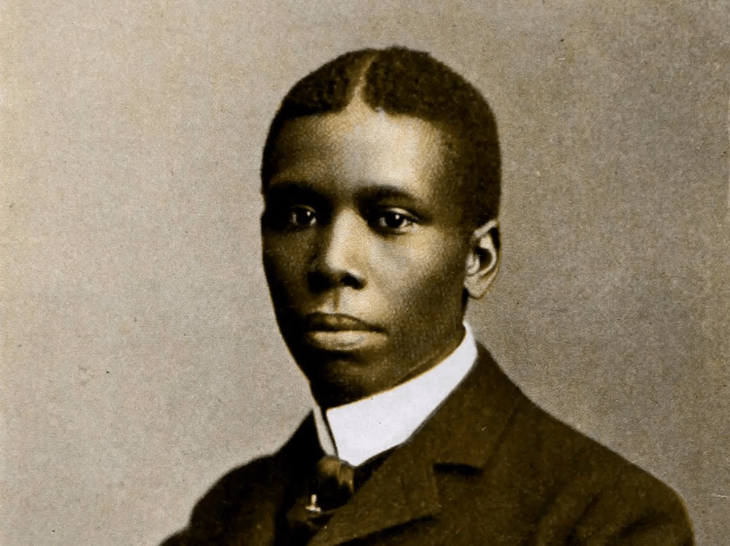
Dunbar died in 1906 at the tender age of 33. In his short, prolific life, he used folk dialect to convey both the experiences and dignity of Black Americans during that early part of the 20th century. He was the first African American to be published and able to make a living as a writer. His work helped swell the ranksof the New Negro Movement and Harlem Renaissance.
He is also credited with one of the most famous lines in black literature, "I know why the caged bird sings," which comes from his poem "Sympathy."
...When his wings are hurt and his heart is sad, When he fights against his limits and hopes for freedom; It is not a song of joy or pleasure, But a deep wish that comes from his very self, A urgent call that he throws up to the clouds -- I see why the caged bird sings!
Published in 1899, "Sympathy" inspired the famed Black author and activist Maya Angelou to take Dunbar's line as the title for her powerful autobiography.
His literary achievements are often overlooked, but they played a crucial role in shaping the works of many leading African American writers, including Langston Hughes, Nikki Giovanni, James Weldon Johnson, Zora Neale Hurston, and Margaret Walker.
In a true sense, Dunbar is the most admired poet by your favorite poet.
Dunbar came into the world on June 27, 1872, to parent s who had previously been enslaved in Kentucky. His mother is the one who raises him, and they eventually settle in Dayton, Ohio.
A student at Dayton Central High School, which was integrated, stood out as an extraordinary writer the only Black student in his class. Above and beyond this distinction he was editor-in-chief of the high school newspaper belonged to the literary club, drama club, and debating society.
He befriended a white classmate who, along in the future with his brother, would build the airplane—Orville Wright. The two ended up fostering a really good relationship which led to working together in business.
The Wright brothers ran a printing press and were first to print the works of Dunbar, including the Dayton Tattler, this being the first Black newspaper in the city; it was founded by Dunbar, who also edited and contributed to it. After high school, paths diverge between Dunbar and the Wright brothers.
Dunbar could not obtain steady income from writing, so he took up different jobs—janitor in an office building downtown Dayton and elevator operator in another building. He was only 20 years old when he seized a business opportunity by selling his first poetry book, "Oak and Ivy," to passengers he met in the elevator.
After moving to Washington, D.C., he got another similar job this time shelving books at the Library of Congress. His wife, Alice Dunbar, who was also a well-regarded writer, observed that it was then, her husband began to think about the notion of a caged bird.
He illustrated how the fierce sun shot its rays into the library courtyard, making the iron grating of the book stacks get warm like something else that resembled prison bars in more ways than one. He noted that the dry dust from old books scratched painfully in his throat, giving him a grasp of what it felt like for a bird struggling against the confines of its cage.
Dunbar's first chance came when he was invited to read his poetry at the 1893 World's Fair; there he met famed abolitionist Frederick Douglass. Dunbar impressed him so much that Douglass offered him a job and called him "the most promising young colored man in America.
Three years later, he had his second breakthrough. On his 24th birthday, he was celebrated with a good review of his second collection of poetry, "Majors and Minors," in "Harper's Weekly," from the noted literary critic William Dean Howells, who also came from Ohio.
The review presented a mixed result. While Howells' praise of Dunbar's dialect use limited Dunbar's ability to sell his other writing styles, it also helped greatly in getting Dunbar launched toward worldwide fame.
His fame did not last long, though. In 1900, Dunbar fell ill with tuberculosis and he died from complications of the disease on February 9, 1906.
His work lives on.
Overall, he wrote 600 poems, 12 collections of poetry, five novels, four volumes of short stories, essays, hundreds of articles in newspapers, and lyrics for musicals.
His poetry has been consistently set to music by composers over the years, ranging from those in his own time to modern-day artists like Carrie Jacobs Bond, John Carpenter, Harry Thacker Burleigh, William Bolcom, and Zenobia Powell Perry.
Florence Price's many versions of her works include popular music and commercial music, while William Grant Still's "Afro-American" symphony features spoken excerpts from Dunbar's poems, tacked on at the beginning of each movement.
Dunbar's influence is felt in both the concert hall and the theater. He was the librettist for "Dream Lovers," an operetta by Samuel Coleridge Taylor, written expressly for Black performers.
The incredible life of Dunbar inspired operas made by composers like Adolphus Hailstork, Richard Thompson, Steven Allen, and Jeff Arwady, all of whom captured his legacy in their creations. Also, the pairing of Dunbar and Will Marion Cook brought forth the first examples of present-day musical theater.
Dunbar's writings honored all of humankind.
He fully changed the plantation tradition by using dialect to give clear social critique, in his poem "When Malindy Sings," while also bringing out the oft-overlooked humanity in works like "When Dey 'Listed Colored Soldiers.
Dunbar's writings give us quick looks into daily life for working-class Black Americans over the years. His poem "We Wear the Mask" sticks out as especially touching among them.
We wear a mask that grins and tricks, hiding our faces and dimming our eyes. This is the cost of human trickery; though our hearts are bruised, we grin and speak with many shades.