
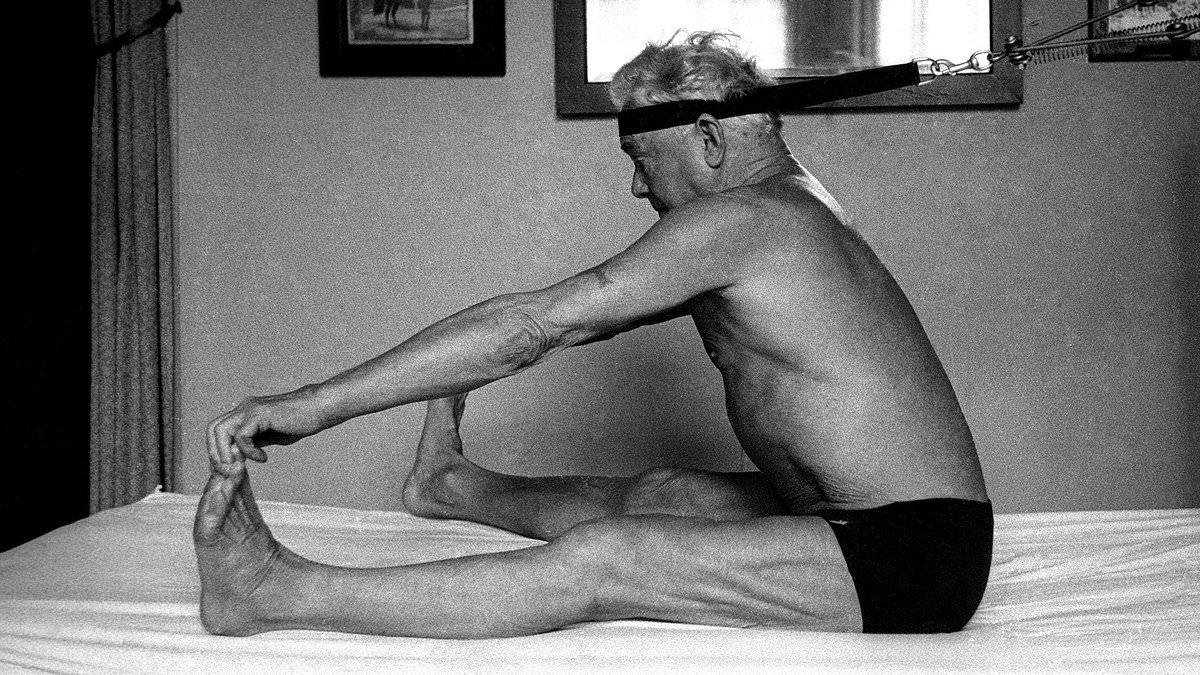
Joseph Pilates is a physical trainer from Dusseldorf, Germany. His childhood was marked by some health issues — asthma, rickets, and even rheumatic fever. These kept him probably very active to pursue fitness and physical conditioning. To enhance his strength, he discovered diversitudes of exercise from yoga, martial arts, diving, and gymnastics. In the early 20th century, he began to develop his method which he named Contrology.
In 1912, Pilates relocated to England where he made ends meet by practicing boxing and working as a personal trainer. During the First World War, his time in a British camp on the Isle of Man saw him develop further enhancements to his regimen — helping fellow detainees keep fit. Later on, he refined his system through working with injured soldiers; springs attached to their hospital beds became reminiscent of an early version of his apparatus.
After the war, Pilates returned to Germany and then relocated to the United States, where he opened a studio in New York City in 1926 that became quite popular with dancers and actors.
Joseph Pilates (1883-1967) was a trainer from Düsseldorf, Germany.
During his lifetime, Pilates devised more than 600 exercises that can be performed on the mat or using his apparatus, such as the Reformer and the Wunda Chair.
Pilates is a method of exercise that has gained popularity as a holistic approach to fitness, bringing together a strong focus on mental and physical coordination, with core strength development, flexibility, postural alignment, and general body awareness as its objectives.
Sarah Westwood, Birmingham.
Bayard Rustin, a Black Quaker and a key player in the US Civil Rights movement, was the first person to use this phrase with its exact wording. In a letter written in 1942, he said: 'The primary social function of the religious society of friends is to "speak the truth to power".' Material for this letter later got picked up in a pamphlet that helped spread the saying.
The expression supports the use of non-violent ways in the fight for social justice against oppression.
The thought behind the saying was not first thought of by Rustin. In a tribute given in 1919 for Senator William Joel Stone, Senator Thomas Gore said, "I respected him because he was one of the rare men who dare to tell truth to the folks in front of the king, and dare to tell truth to the king in front of the folks.
Bayard Rustin, a black Quaker and leading member of the US Civil Rights movement, was the first person to use this phrase with its exact wording.
In 2000, the Robert F. Kennedy Foundation launched an educational program called Speak Truth To Power, based on a book by Kerry Kennedy, one of Robert Kennedy’s daughters, entitled Speak Truth To Power: Human Rights Defenders Who Are Changing Our World.
Dos-a-dos bookbinding, a term derived from French and meaning 'back-to-back', is the technique where two separate volumes are bound together sharing one back cover and opening in opposite directions.
Dos-a-dos bindings were functional as well as visual. Often, paired religious texts appeared in the same book. For example, a Psalter might be coupled with a New Testament, for easy access to both scriptures and hymns during worship services.
In secular contexts, poetry may be combined with an associated prose piece, or two related philosophical essays may be merged. Also, some dos-a-dos books display paired writings, like different translations of the same work.
Questions for tomorrow:
Which national anthems mention other nations in their lyrics?
Ken Hobbins, Birmingham.
Living on the south coast in Barton-on-Sea we can see two lighthouses one at the Needles on The Isle of Wight and the other just next to Hurst Castle near Milford-on-Sea. Are there other coastal areas where it is possible to see two or maybe more lighthouses with the naked eye?
Ian Thomas, Barton-on-Sea, Hampshire
What was there within the original twin towers of Wembley Stadium?
Jim McDougall, from Reading, Berkshire.
Advertisement
This kind of binding was especially liked during the 1500s and 1600s, having a useful aim when books were often taken around for daily use. Peter Finn, Matlock, Derbyshire. QUESTION: Which creature has the power to notice the widest range of colors? Also, in addition to the answer before, some snake types, like boas, pythons, and pit vipers, hold the chance to feel radiation in the far infrared (IR) spectrum.
These snakes have a set of heat-sensitive pits located on their heads. The infrared image, though not as detailed as a visual image processed by the eyes, gets transmitted to the brain's visual regions where it combines with visual information to create an improved image under low-light conditions. As a result, when animals emerge in the desert after sunset, snakes like the rattlesnake can find their prey.
Another creature known for its infrared vision is the vampire bat. Unlike most bats, which hunt insects using echolocation, the vampire bat feeds on the blood of larger animals. As a vampire bat glides over a dark field where cattle are grazing, the cows may be seen by it as if they are glowing.