
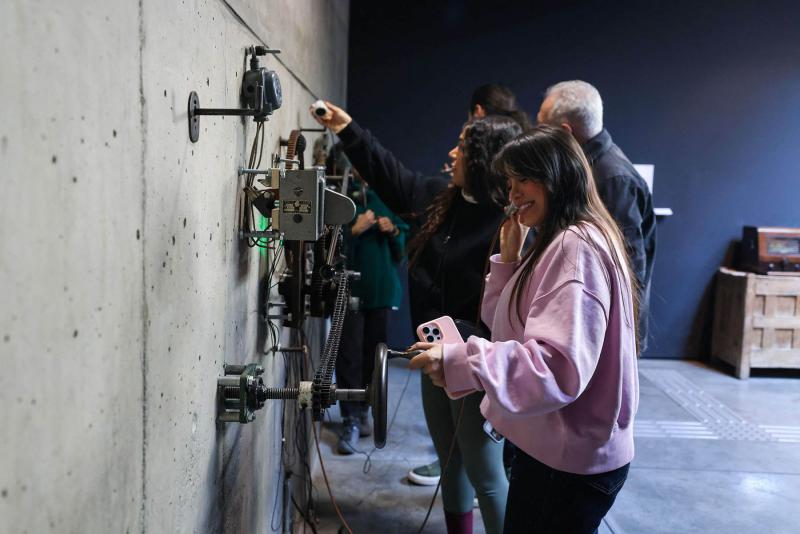
At an exhibition titled Iran's Sound Scene in Tehran on February 4, 2025, visitors engage with a variety of installations featuring devices and mechanisms that produce sound. (AFP) Inside a century-old building in Tehran, Saeed Anvarinejad tuned in on a knob of an old radio to some of the earliest recorded audio in Iran, bringing back memories of the important changes that have shaped the country’s history.
With a team of similar-minded people, he spent months trying to find the oldest recordings of Iranian music, talks, interviews, plays, radio programs, and even the sounds of daily life from over a hundred years ago up to now.
"This is the city of Tehran!
"'Sound is something we often ignore but it has great value' said Anvarinejad, one of the helpers in the 'SoundScape' show.
The era of early sound recording in Iran in itself bears great significance toward the country’s socio-political history.
He stressed the strong emotional impact of early voice recordings, saying that they reflect "in a very raw and pure way ... the feelings people have at that moment," something different from written accounts.
The earliest known sound recordings from Iran date back to 1898 and 1899 which were years that coincided with the reign of Mozaffar al-Din Shah Qajar over a dynasty governing the nation from the late 18th century up until the early 20th century.
The Constitutional Revolution was witnessed during his reign, which marked a vital turning point in the political transformation of Iran; it resulted in the establishment of a parliament and a constitutional monarchy. "It was the time when ... a new perspective was coming into being in the Iranian consciousness, and great developments were taking place in politics, society, and culture," he said.
We thought it might help to take a new view on the music from that time and relate to listeners through it.
As I turned the knob on the antique wooden radio, a startling bulletin came in regarding the 1953 ousting of Prime Minister Mohammad Mosaddegh who had pushed the nationalization of Iran's oil industry and hence became the victim of a coup plotted by America and Britain.
Tehran! Great news! Great news! Citizens of Iranian cities, be vigilant and aware; the traitor Mosaddegh has escaped!' it voiced from a crackling radio.
'Enigmatic emptiness'
More audio included Iran's inaugural recorded call to prayer from either 1912 or 1913 and a report from 1959 detailing the death of Qamar, the first female singer to perform publicly in the nation.
A good part of the exhibition was a mechanical arrangement, fastened to a wall of concrete, made up of the gears chains wheels and a lever that played old recordings of the stringed tar instrument using antique telephone handsets.
Another work, called "Mowj Negar," showed sound waves printed arranged in three rows on a wall, along with a metal device that moved over the waves.
It plays music from the Qajar and early Pahlavi years (1925-1979) that wafted through the great palaces and cheerful streets of Iranian cities when triggered by movement.
There was a wooden cupboard nearby, called "The Silent Closet," in which soundless photographs from the First World War were exhibited.
"There are no audio recordings from Iran during this period not because there was no technology but probably because the country was in great turbulence checked with the low priority of sound recording," says Atabak Axon, another exhibition organizer.
This 12-year gap, audibly silent in Iran's past, persists as a mystery.
For hundreds of years, in Persian culture, it was integral to have sound as a part of it. Faith connects with poetry through sound, and and or it builds identity.
For 21-year-old Sarvin Faizian, it was an emotional experience going to the exhibition with friends, making her feel like she was reliving her parents' history.
In a similar vein, Fatemeh Sadeghi said she was deeply affected by feelings of nostalgia. 63-year-old Kamran Asadi found the exhibition surprisingly intimate.
'It's a really nice and cozy vibe for me,' he said, taking a moment to listen to an old song that was playing softly in the background.
Young people should benefit from knowing the roots of Iran's musical and artistic heritage.