
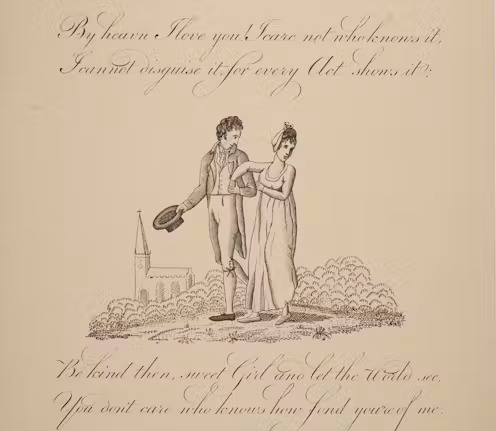
A well-known Victorian Valentine’s Day card. Valentine Card created by Jonathan King, 1860-1880. London Museum, CC BY.
Mass production and the division of labor are not typically associated with our thoughts about Valentine's Day. Instead, images of chubby Cupids, hearts, and roses come to mind. However, these industrial processes were fundamentally important to the historical development of the holiday.
As a historian who focuses on material culture and emotions, I would argue that the spread of commercially produced greeting cards contributed significantly to the 19th-century development of Valentine's Day as a celebrated holiday.
At the start of that century, most valentines in Britain were made by hand. But by the 1850s, factory-produced cards had replaced home-made ones. By the 1860s, over a million of these cards were circulating in only London.
A card that caught his interest was one that showed a couple walking arm in arm on a path leading to a church; this was later to become a well-known image. Halliday recalled being intrigued as he saw "the windows of small booksellers and stationers" bedecked with "highly-coloured" valentines, wondering "how and where" they had "originated." He found himself questioning "who creates the illustrations" and "who composes the poetry?"
He is best remembered for his landmark social survey, "London Labour and the London Poor," which examined London’s beggars. But in the 1860s, he was a regular contributor to Charles Dickens’ famous periodical "All the Year Round," writing with such engaging flair about familiar features of life in Britain — family relationships, travel, public services, and various forms of entertainment.
In an article for that magazine titled "Cupid's Manufactory," which was later included in the 1866 compilation "Everyday Papers," Halliday took his readers on a tour of one of the top card makers in London.
Within the walls of "Cupid and Co.," they traced a valentine from start to finish, beginning with a simple sheet of paper and ending with the tidy white box that holds it along with similar items, ready to be distributed to retailers.
'Cupid's Workshop' Come With Us
It was probably the business run by Joseph Mansell, a firm lace-paper and stationery which killed off a good deal of valentines between 1840s to 1860s and was conveniently located in the same place as "Mr. Cupid's" in Red Lion Square, London.
The techniques that Halliday described were standard among other British card manufacturers during the 1860s and corresponded to many industrial practices that had developed from the late 18th century onwards—task division and the employment of women and children as workers.
Halliday explained the place called "Cupid's Manufactory" and the methods used to produce different styles of cards for different types of people, different social classes, and different prices.
He noted that the card showing the couple stroll͏ing along the path to church began life as a simple black-and-white stamped card, like one that is still held in the collections of the London Museum and was sold for a penny.
Some of these cards were then sent to a room where a lineup of young women sat on a bench, with each one having a different shade of "liquid water-color" beside her. One of the women used stencils to paint the "pale brown" pathway and passed it on for the next woman to paint the "gentleman's blue coat." This process kept continuing with every woman in the lineup contributing her part and the next one painting the "salmon-colored church," and so forth. It was just like that other scene, a similar one really, of female workers making valentines in the "Illustrated London News" during the 1870s.
Halliday noted that the colored cards were sold for about "sixpence to half-a-crown." But, some of the cards were taken to another room, and there a different group of girls added feathers, lace-paper, bits of silk or velvet, and even gold leaf. Such cards were sometimes sold for 5 shillings or more for fancier ones.
In all, Halliday saw "about sixty workers," mostly young women, along with "men and boys," who toiled ten hours a day every day of the year making Valentine's Day cards.
Yet it was on the top floor of the building that Halliday met the people who interested him most—the six artists who created all the cards and the poets who wrote the words, the majority of whom worked from home.
These were the people who generated real emotions by means of the cards, and they spoke for a far greater range of feelings than those expressed by Hallmark and others in the 21st century through greeting cards.
Victorians often sent cards not just to their romantic interests but also to those they held in disdain or wanted to ridicule. Cards were made for this purpose, specifically to insult people working in certain professions, like tailors or draper's assistants, or those who were unfashionable.
Cards had been designed to dissuade the wooers and to deride those who were senior or less comely. Though it's likely that some of these cards were passed around as jokes among friends, most scholars believe that many were unmistakably intended as stinging jibes.
Also, unlike today, in the 19th century, people who got a Valentine were expected to reply back, hence cards were made that could stop more wooing, ask for time, show thanks, say fondness, or confirm love feelings. Halliday noted that the poet employed by "Cupid's" had just finished making the script for a nasty funny valentine showing a man staring at his reflection in a mirror. Looking at yourself in the mirror
You appear to be brimming with admiration.
You are deceiving yourself and thinking, oh no!
You are a fantastic specimen of what may be brought into existence.
Yet, this same author had previously created a different sort of text for the card that Halliday had referred to earlier, which demonstrated the "lady and gentleman heading to church.
"I would willingly take the way that is in front of me,
With the person who is nearest to my heart.
To that church over there, the revered sacred site, Where I would gladly share my promises of love; And join with you in the joyful bonds of marriage, Oh, how fortunate my life would always be! The same individual produced these distinctly different texts. Halliday confirmed to his audience that "Cupid's laureate" had written numerous other works throughout the year, showcasing every conceivable style and emotion, all for "twopence a line.
Halliday showed how an outsider was creating feelings intended for other outsiders who bought them. He even told his audience that days before Valentine's Day, "Cupid's" was making valentines worth two hundred and fifty pounds each week and that his business was "growing annually.
Halliday saw this card-shackled world—mass merely to help people transmit what might be their truest feelings, all for profit—as interesting and strange. He thought it was a thing that seemed to be "beneath the dignity of the age."
But, it did prosper among the earnest Victorians, and it does prosper still. Actually, it's become a vital part of modern Valentine's Day festivities.
This year, much like all the other years, I will find myself standing with a bunch of strangers at some greeting card display, all of us searching for that one perfect card, made by someone else and mass-produced for profit, which will express our real feelings for friends and family.