
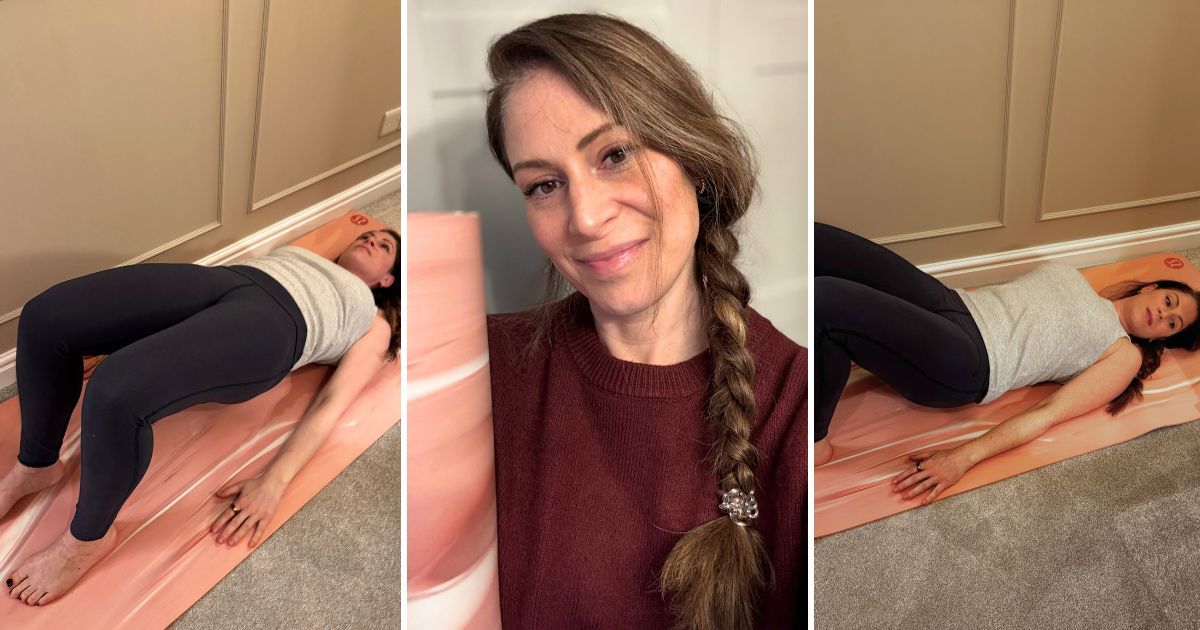
Of all the classical Pilates exercises, the Simple Shoulder Bridge typically shines. This movement would probably be among the first exercises ever done in a Pilates class, either on the mat or during Reformer practice presents the eighteenth movement among the 34 original Pilates exercises developed by the founder of the method in the beginning of the 20th century.
The shoulder bridge is not at all a complex exercise in respect of its composition, but it really comes hard to properly execute it doing the right things — engaging and articulating and strengthening the spine, glutes, core, and hamstrings all at the same time. This exercise is very much effective for improving hip mobility, which still doesn't come easy for me despite regular and consistent practice of Pilates.
Another addition we feel is trying to bring in a shoulder bridge. This would be a fabulous strategy to beat the drear effects of having sat through the day at a desk. Since it would be possible to achieve a spinal movement plus getting the hip into extension, there you are, an excellent way of full-body engagement.
When I got a chance to test the shoulder bridges every day for a week, my heart was filled with hope. Will it really help me improve my spinal mobility, hip flexibility, and back strength? Results unveiled – go ahead and read to know how my experience turned out.
To learn more about Pilates, check out our guides on the different types of Pilates, the best ever Pilates workouts, and getting the most out of mat Pilates. Find out about one Health Writer's experience with performing Pilates toe taps daily, right here.
First, let's go back to basics and see what the Pilates shoulder bridge involves.
Claire Mills, a physiotherapist, Pilates instructor, and founder of Core LDN, says that the Pilates Shoulder Bridge is truly a full-bodied exercise. It involves deep abdominal control, as well as glutes, back, and hamstrings to stabilize the body so that you can lift your hips into a bridge position. The action is peeling up and lifting the hips to bridge while opening up the body into one straight line. Articulate the spine from top to bottom to get back to the mat, vertebra by vertebra.
That seemed pretty easy up to this point, didn’t it? How about we slot in an extra element of vigor in the classic Pilates style? “In the classical traditional version, after you rise into the bridge, you lift one leg straight up towards the ceiling,” says Mills. “As you raise the leg, point your foot, then flex it as you lower the leg. There are also variations that involve bringing one leg into a tabletop position.”
Whether you’re just finding out about Pilates or you are really starting to gain some momentum in your practice, you’ve probably heard a lot of good things about what it can do for you. From improving mental focus and decreasing stress to flexibility and ease of motion, some very strong reasons would encourage you to take up Pilates as part of your fitness routine.
Other studies, such as one randomized controlled trial published in Osteoporosis International, proved that some specific spine-strengthening exercises, bridges, caused improvements in spinal curvature. Other benefits are as follows:
According to Pilates instructor Aleksandra Warburton, "There you have it, the Pilates shoulder bridge – a classic exercise to work your core and lower body. It focuses on waking up the glutes while giving mobility to the spine and control to the core." She elaborates further, "This will help with core stability as the deep abdominal muscles will finally come on board to hold the pelvis in the correct position and protect the lower back.
This further facilitates a total posterior chain- back, glutes, and hamstrings; hence intrinsic strength and stability begin in the pelvis.
The main action in a shoulder bridge is lifting and lowering the spine, ideally one vertebra at a time. Mills states that "This movement up and down enhances and promotes spinal mobility." It can help decrease back stiffness and increase conscious awareness of spinal movement.
Joseph Pilates is recognized by his statement, "a man is only as young as his spinal column," and this ideology underpins the shoulder bridge movement. Warburton agrees and says, "Bridges are an excellent exercise to maintain a mobile spine and strong body; thus, I believe this should fall under the category of a fundamental pilates routine."
One main feature of human life in contemporary settings relates to the fact that most people lead somewhat sedentary lives; even the relatively active ones spend much of their workday seated. This behavior is damaging to our skeletal well-being; it induces the shortening of hip flexor muscles and leads to a variety of problems located in the back.
To reverse the effects that long hours of sitting might have, lazy glutes, and tightness in front of the hips, one should consider including shoulder bridges in their workout. Shoulder bridges will be of much help in opening up the hips.
You probably hit that bicep curl and do a great job with leg workouts, but how often do you honor the commitment to back strengthening exercises? This is where experts really harp that we should not lose sight of the benefits that come with having a strong back.
Shoulder bridges do more than just strengthen the posterior chain. They also enhance spinal mobility; which may be of benefit when considering back pain. "Shoulder bridge work is very good for back pain and injuries when looked at from a physio perspective," he says.
In addition, have you heard? "In low back pain, sometimes the multifidus, which essentially creates control of the vertebral movement, becomes shut down," she explains further. "The shoulder bridge exercise—particularly in the leg reaching or leg in tabletop option—can be used as an effective means to re-wake that muscle and help in the restoration and further enhancement of back strength.
It is not very effective to go through the motions without staking a claim on your form and technique; doing so may lead to injury and may prevent you from experiencing any real benefits. Therefore, you need to really take the time to understand the patterns so that you can start off on the right foot.
He also says that one should consider the following tips:
Shoulder bridges are referred to as a Pilates classic, and I must admit that I have not ever given them much focus before this week. Looking forward to getting going. After the first session, the fact that Pilates is truly a practice as opposed to something to be done becomes crystal - I feel like this is my very first shoulder bridge as a beginner.
Though I have done my share of bridges in every mat class and favorite reformer class, now that the benefits and right techniques are known, it's like doing them for the first time. This more profound association with movement is definitely an intended consequence.
As I often find, if I focus on the minutiae of the workout, it seems to get substantially harder—it is true that Pilates never gets any easier! In the days leading up to my first session, my hamstrings and hips, which had been through a punishing spin class over the weekend, as most other parts were very tight.
By the third day, however, more relaxation creeps in and I am able to better concentrate on my spinal articulation (hard to do that when my hips are protesting!). I also note a mild backache. It was hinted to me by some of the gurus, so now I am assuming that this might be an indicator of my glutes and core not getting properly activated, and hence I shall have to get back to the basics for the time being.
"Warburton suggests not over-arching the lower back. Try to think about getting the glutes to fire rather than lifting the hips up too high. If tightening in the low back is felt, find time to reestablish the posture and ensure the action starts from the glutes and core while keeping that core engaged to assist the motion.
The advice I collected tells me to focus on getting the basic bridge down before making any changes (the leg lifts will have to wait). The professionals were right—better core engagement (and my breath) and I can feel my lower back set in motion. My spine is nearly (nearly!) something I can feel moving in the lumbar region; my thoracic spine feels a lot more relaxed—precisely what I wanted to achieve.
On day five, however, when I actually feel like giving the leg lift a try, shortly after trying it, I notice that my form is starting to break down, and right then, the trade-off doesn't seem worth it, so let's just stick to trying to wake up my glutes, which I can feel much more than I did earlier in the week. I must remember, though, that it's not very smart of me to take a strength class and then do my daily bridge, since I wake up the following sore with a bit of ache running down the left side of my hip.
One of my favorite and simplest core movements in sitting is exercised on the bridge. Generally, my hip flexors tend to come in many of the seated core movements once my core starts to fatigue. But in this case, they cannot take over, so my core is continuously engaged. I will also try to time my movements with my breathing, raising my hips as I exhale and lowering as I inhale.
At the close of the week, the improvements total in shape and technique. But what about extra benefits? Certainly—I have felt a decrease in back pain and an increment in mobility at my mid-back area. To actually feel some dramatic improvement in core and leg strength, I would say, some more weeks to go.
The most important thing that falls out of that is to not succumb to the temptation of always trying the advanced versions of exercises. While I have a competitive streak and love to see progress, I’ve found that in Pilates, sometimes, less is more — you get much better if you just focus on the basic moves.