
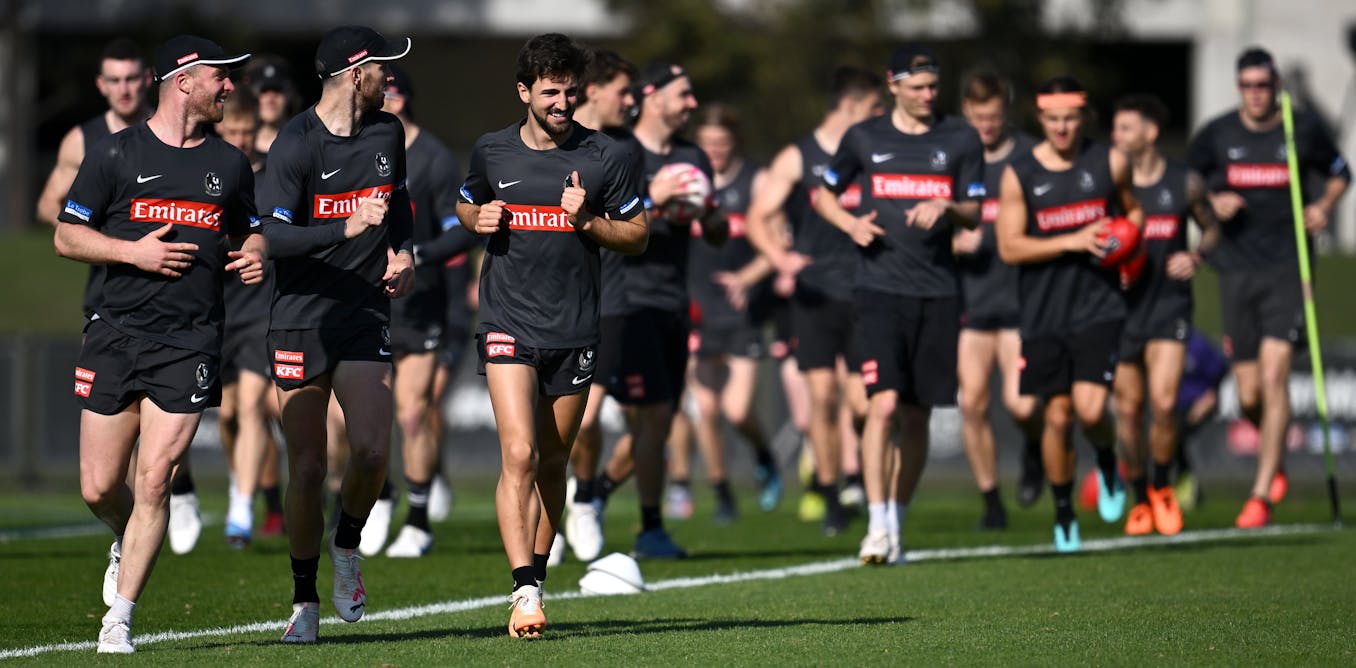
The big footy codes in Oz, like the Aussie Rules League (AFL) and National Rugby League (NRL), are pretty popular. One thing that jumps out to folks watching from abroad is how long the pre-seasons are for these leagues.
Unlike global sports such as soccer and the NFL, which typically have pre-seasons of several weeks to two months, the pre-seasons for AFL and NRL can stretch much longer, often reaching four months or more.
What is it that these two codes, more than almost all others, afford such a significant amount of time to pre-season training?
It lies in the mix of all the different physical qualities required to play AFL and NRL, along with the higher risk of injury that arises from shorter preparation periods.
High impacts with diverse physical demands
Both AFL and NRL are considered contact team sports. Athletes have to run at make significant distances quickly while engaging in frequent physical contact.
AFL players can run 12 to 17 kilometers during the match while performing at very high intensities and also carrying out much technical work like kicking, catching, handballing, and tackling.
NRL players face similar challenges. They have to suffer more than 30 significant collisions in each game, besides also having to participate in many instances of intense activity like running and sprinting.
The mix of stamina, power, and might with the high touch needs makes it a real test for practice.
Off-season training plans ought to aim at building different body skills. These skills include stamina to keep up high efforts over a period, quickness and nimbleness for both closing in and creating space as well as strength and might for taking part in falls grappling and cases with troubled balls.
A shortened pre-season might limit the time required to adequately develop each of these traits. Consequently, this increases the likelihood of injuries during the season and results in a general drop in performance.
Longer pre-seasons and ways to prevent injuries.
One of the big pluses of long pre-seasons, seen from the angle of sports science, is that training gets tougher slowly. This way helps to lower the chances of injuries when the season begins.
Research has shown that progressive overload (which means slowly raising the level of intensity in a safe and planned way), good management of rest time, and enough conditioning are key for coping with what is needed during the season.
It is evidenced that higher involvement in pre-season activities, extra training sessions, and greater total workloads (such as total distance covered) will minimize the number of games lost due to injuries in the season.
These outcomes give an insight into the fact that a disciplined and elongated preparation phase, which is perceived to be tough, can create strength.
Clubs can prep their athletes for the tough trials of an AFL or NRL season by gradually and methodably putting them In acclimatization to different levels of running intensity, physical contact, and skill training sessions.
What roles do other codes play?
European football clubs usually suffer from little break between league seasons and international matches.
The pre-season is usually characterized by big international friendly tours which leave little time for the rigorous conditioning programs that are common in AFL and NRL.
Also, the injured players can easily be replaced without a draft system through the transfer market. This reduces the incentive for long pre-season training to keep key athletes healthy.
The NFL pre-season is short. It looks like a training camp and has multiple pre-season games where "starters" play very little because of injury fears.
Due to the stop-start nature of the sport, in addition to the specialized positional demands placed on athletes in this sport, players require a certain physical profile. On the other hand, athletes in AFL and NRL need to have a more rounded physical profile.
In recent years, the NFL has become more aware of the increasing injury rates that accompany dramatic increases in training load. Thus, it is now considering longer or modified pre-season protocols which are to be partially designed to help reduce injury risk.
Changes could be on the way.
Strangely, this year the AFL might find itself experiencing a similar scenario.
In the last off-season, many AFL teams had only two to three weeks of organized training with their entire squads before taking a break for Christmas; afterward, they took three weeks off.
While this approach is intended to allow players a bit of rest, it can inadvertently lead to similar outcomes as the NFL in which reduced preparation times tend to associate higher incidences of tendon and soft-tissue injuries.
Sports scientists in Australian teams will meticulously monitor training loads as players return to avoid pitfalls associated with the hastened shift to rigorous tournaments.
There is a justification for these protracted pre-seasons.
Allocating three to four months to pre-season training is not merely a strange characteristic of the Australian sports calendar.
A balanced response to the high demands in those codes is needed. Greater than this, however, is the fact that a properly managed lengthened pre-season significantly reduces injury chances during the season.
Thus, clubs are to find a way to balance resting the players with ensuring there is sufficient time for a planned and organized off-season to improve performance and reduce injuries.
Given the evidence, it is not surprising that Australian codes place such a strong emphasis on this important preparation stage.