
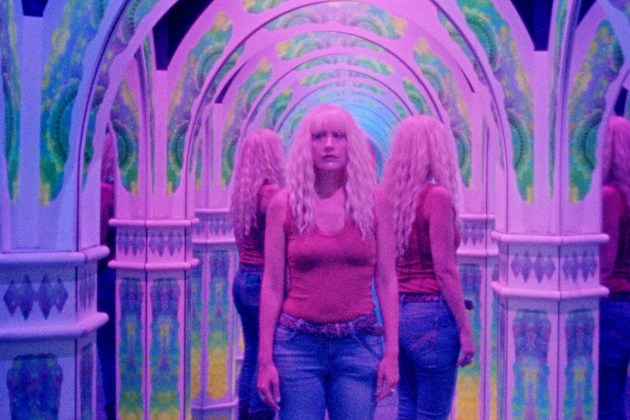
"Sirens Call," the feature debut of Miri Ian Gossing and Lina Sieckmann, showcases a hybrid form that reflects its hybrid protagonist—a human who was formerly a merwoman and now traverses the land. Radical in both political and artistic senses. Like its subject, the film resists simple classification, existing in a space that merges elements of science fiction, American road-trip narratives, and folklore all to the echoing style of "Koyaanisqatsi."
The film gives beautiful and story turns that are both totally surprising and yet clear when the parts fit together, gently revealing deep truths that viewers might feel they have always known at a deeper level. This smart control in film gives a lively view on human bodies with regard to disability and gender dysphoria— first as a metaphorical fantasy, then as a real political challenge. Even explaining its starting point takes work, but every minute of its two-hour length feels well-timed.
More from Variety.
Shot in the present with 16mm, the film achieves a quality that mistily total strips it of any temporal context and projects into the past. The opening scene, set in a peculiar laboratory, presents startling neon colors; yet, it places the movie within flashy B-movie categories. The voiceover does everything to anchor it in documentary style: the directors interview Una (Gina Rønning), a middle-aged woman. This juxtaposition becomes characteristic of much of the first half of the film, as Una reveals her past—mermaid come home to an alien world. It establishes an observational viewpoint to which "Sirens Call" remains firmly bonded. As Una travels through America, there is an upsurge in right-wing repression in the airwaves with news targeting transgender people, making "Sirens Call" evolve into a reflection of contemporary America and its battle for authenticity.
In the night scenes of US cities—crowds in costume, pyramids at Las Vegas, chain restaurants at New York, and fast-food places like Taco Bell that serve particular ethnic groups—Una's feeling of alienation from modern society becomes very sharp, showing a culture that seems to consist entirely of copies. These notes make for disturbing moments, as this self-identified water being (who looks a bit unsure about having legs) begins to try on different wigs for herself at aquariums and venues where women dress as mermaids and entertain paying audiences.
At every moment, she meets a commercialized version of her former self. The movie, which switches between scenes of Una being interviewed and moments where she speaks to a disembodied camera in a dramatic manner, walks the line carefully between reality and drama. It poses the question: what does it really mean to stay authentic in a world that is always changing and developing?
In the pursuit of being real, Una starts to listen to some self-help audio recordings that guide her on creating friendships and daily life. After moving to smaller towns, she tries out these communication techniques with various men she meets in mundane parking lots and finally finds connection with a nonbinary Tarot card reader Moth (Moth Rønning-Bötel), discovering comprehension and reflection in their mutual outsider feelings. Little by little, this low-movement tale begins to ready for the movie's second part in surprising ways that, upon thinking, feel enlightening.
At a certain point, shifts happen. First, the film starts to break out of its realism and becomes vibrant, kaleidoscopic imagery; then it switches from dramatic staging to documentary-style staging with talking heads and a completely new set of people. This kind of total reversal keeps a close line between two differing perspectives on reality— the constructed and the "real"— as it makes sense with actual members of a merfolk community in Portland. From a distance, they might be perceived as LARPers and cosplayers. Yet, through the film's unconventional approach to reality, dramatizing the mythological, it elicits much deeper empathy from its viewers as these people openly share very complex connections that they have with trauma, gender, and sexuality, as well as their different coping strategies.
What might have read as either sharp or condescending in another picture is turned into something quite lovely, as every gem-like human is revealed in monochromatic light. (One person is even caught moving, like the 'Serpentine Dance'.) "Sirens Call" has a palpable historical significance that feels intentional and transformative, with even its subtler things becoming layered and complex when the film's seemingly contrasting narratives—its interviews and sci-fi exploration—intersect in surprisingly heartfelt ways, uncovering the poignant truths that shaped the film's fictional narrative.
While no one says it outright in the documentary part, as soon as people start to talk about their love for dressing as merpeople, it is understood that their lifestyles matter to them as much as life itself. The film puts its focus on a community of politically engaged individuals with varied experiences and much of the footage (shot in 2020) speaks to protests against police brutality and conversations around acceptance. In "Sirens Call," it's not the words that carry the political message; they work to highlight the radical politics expressed through visuals, seeking to unveil different understandings via compelling mixtures of dramatic expression. There is truly nothing else like it.