
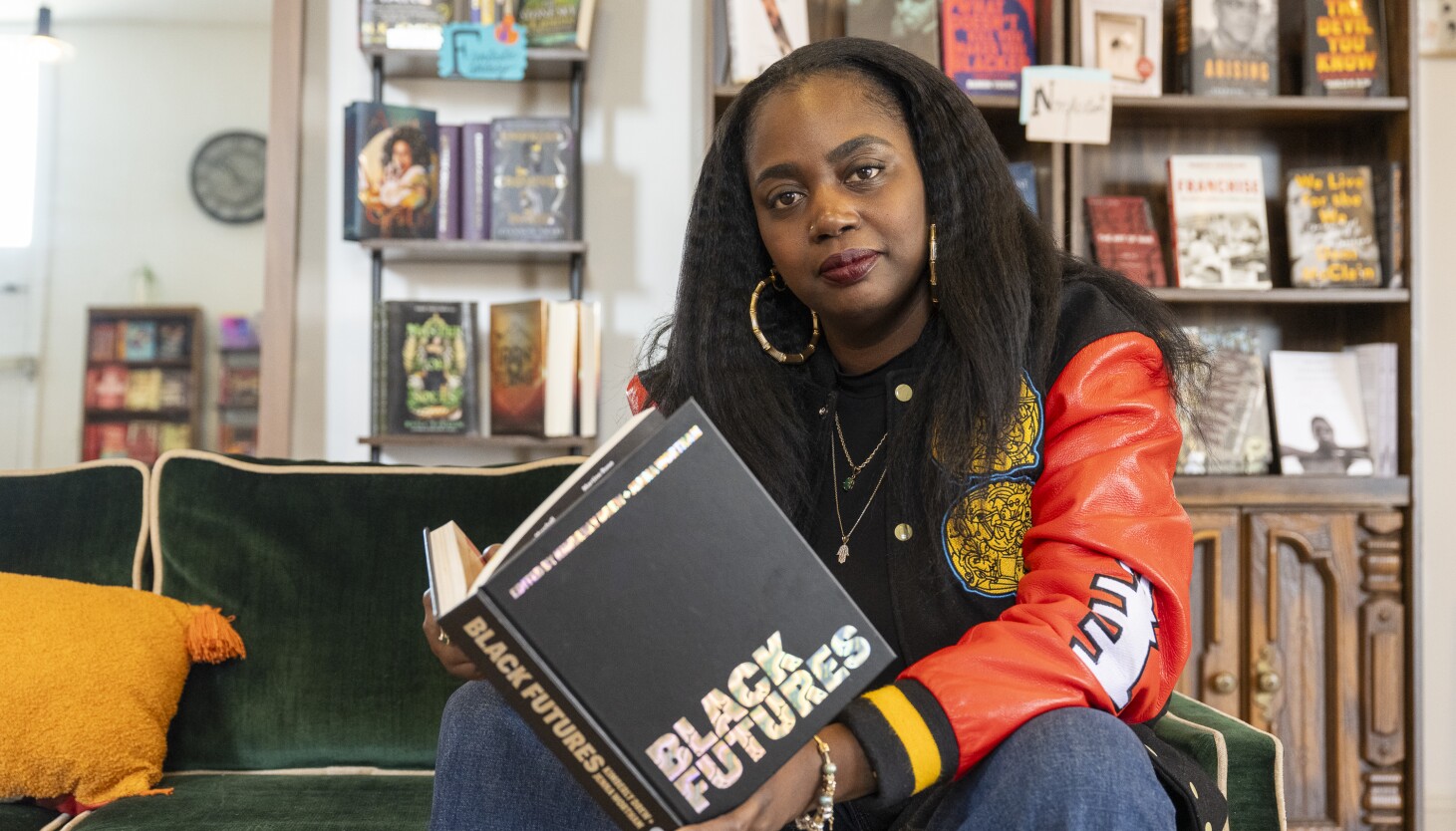
The summer of 2020 is not something Moore, the owner of Semicolon Books, is likely to forget in a hurry.
Within weeks of inner-city unrest following George Floyd’s murder that May, Semicolon saw a surge in customers, all eager to support its inventory of Black authors and writers of color.
Semicolon, a Black-owned bookstore in Chicago, had a solid business for the rest of that year. But, Moore said, the store found it unexpectedly difficult to manage the depth of emotions of both their customers and themselves.
We were keeping ourselves occupied at all times so that we would not have to think about the George Floyd incident, while being in closed COVID environments with no one to share emotions with.
The bookstore is now in another hard time. Moore had announced in January that both the Magnificent Mile, opened in 2024, and West Town would be closing this year. However, she later stated that the one in West Town would remain open after all, for the lease commitments, and they would go into fundraising so they could set up a little coffee shop.
Black booksellers said they experienced a large increase in interest during the racial justice movements of 2020 and were getting more corporate and individual support amid the Black Lives Matter protests.
By 2025, owners and analysts warn that the Black bookstore scene in Chicago will face dwindling engagement, politically as the playing field changes, and less support from white allies. A surge of solidarity, early on impressively shrunk significantly, with businesses experiencing fluctuating sales and narrow profit margins.
Only about five bookstores in Chicago are Black-owned, according to the Sun-Times.
This is surprising for a city that had black-owned bookstores earlier than most other places.
“Chicago has a rich history of Black booksellers that dates back to at least the 1940s,” said Joshua Clark Davis, a historian at the University of Baltimore.
Davis said the first big surge of black-owned bookstores came in the 1960s and 1970s when stores were community centers for political engagement.
Davis, in 'From Head Shops to Whole Foods,' sates that many Blacks who start bookstores do so out of passion for books but with a political or social agenda in mind. Specifically, he has in mind the Black-owned bookstores that grew out of the protest movements of the 1960s and 1970s.
Overall, the businesses’ popularity fluctuated, peaking in the ‘70s and ‘90s. Black nationalism in the 1990s and Afrocentrism in the 1970s had a lot to do with this Nationality’s highest peak was in the ‘70s and then ‘90s. It went down during the 2000s and 2010s because Black nationalism was on a decline and Amazon emerged, along with e-books, and audiobooks.
Davis stated that independent bookselling had reached a nadir, but recovery began in 2020. The timing of this revival was around the time of George Floyd’s death, which energized the black communities to confront systemic racism.
Hence, there was a demand for antiracism literature that kept businesses going at Black-owned stores in the Chicago area.
Before long, the national zeitgeist was highlighting Semicolon with other Black-owned bookstores in relation to the rising demand for antiracism literature. Indeed, The New York Times went on to say that these bookstores were “overwhelmed” by the increase in book sales.
Companies wanted to show solidarity and started placing enormous quantities of such books as ‘How to Be an Antiracist’ by Ibram X. Kendi. But the spike in orders was short-lived, as told by the owners.
Gorham added that “Our most successful year was probably 2020 because of corporate book drives and fund-raising for which we're receiving money from people. But as priorities have changed, we now struggle to maintain our visibility.”
"After George Floyd incident, I was getting orders and payments all over the country… but it stopped after a couple of months,” Ahmechshadye said. “They did some work, it’s just that, as they say, without ongoing commitment, the effort is pretty meaningless.”
By 2022, there were no corporate donors or orders as the corporation’s executives admitted, “The other competition out there is Amazon because they offer lower prices” – a mere passing fad, as they would say, of our support.
Some individual buyers may have been “virtue-signaling.”
They treated [racial justice] as if it was a moment rather than a shift in mindset.
Others believe that a hard swing to the right politically also diminished backing, as Davis relates.
Heads of states have a huge role in ensuring the security of their nations, from the smallest units to the national level; this is just one of the responsibilities of a head of state in a country. Original: The historian remarked, “It seems that Black bookstores are facing increased challenges lely due to the significant backlash against antiracism efforts and movement to address racism.” Ongoing support from all customers, especially loyal Black buyers, is essential for survival especially during economic downturns following Covid.
Gorham is quoted as saying, “It was such a bummer when Dani [Moore of Semicolon] decided to close their store. They’d been pounding the pavement for years to get consistent support…I don’t think the community really realizes how integral their involvement is in keeping us open.”
At shops including Semicolon, Call and Response in Hyde Park, the mother-daughter run Da Book Joint, Underground Bookstore, and Burst Into Books, a great number of the books are works by Black authors and authors of color based on what readers want and what the staff is interested in.
As Woods from Da Book Joint pointed out, “We do not think of ourselves as a ‘niche’ bookstore. We carry every genre—all by Black writers. White bookstores aren’t called ‘niche’ for carrying stories 99% written by white authors.”
Bledsoe from Call and Response noted that many assumptions about the offerings of Black bookstores are often incorrect.
Most periodicals using a Black figure on the front end may all be ‘struggle stories’ in the general perception of people. Yet, ours contain human experiences like love, science fiction, and happiness. ‘New York Times’ bestsellers” ‘We are supposed to share the space with New York Times bestsellers.’ ‘This is community space… it’s not just for black readers.‘
Owners say online retailers do not provide the experience local bookstores do. “We can’t match prices, so we stay true to our mission: hosting events, author discussions, unique conversations that you can’t find online,” said Verlean Singletary, 54, Woods’ mother and co-owner. Many also have children’s books.
Singletary also emphasized that “We are after children finding books they can relate to. When they meet characters that look like them and stories that sound like them, it’s a breeding ground for reading.” He added, “We don’t make profit. We really reach a break-even point. This is not about salaries; it’s a mission. And we’re going to continue to advocate just because of the fact our community is worthy of this space.”
Ahmechshadye is determined to expand his cramped bookstore into a much larger venue with rare books and a juice bar, though he admits that he has come close to shutting the business several times.
"I shouldn't have to struggle," said the 69-year-old bookstore owner. “This is the third largest city in the country, so there are plenty of people in Chicago — African Americans in particular — to keep the last black bookstore or at least support it.”
"I often think of shutting down," he said. “But every time some young person comes in feeling lost, looking for answers, that’s why I carry on.