
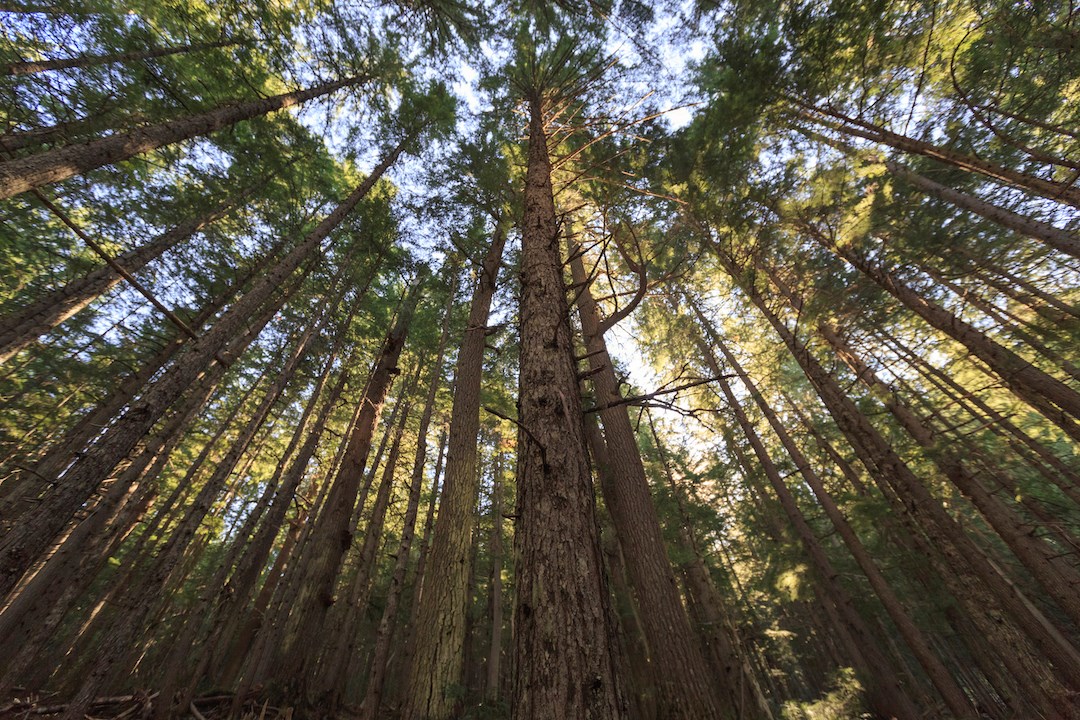
It can help planners boost 'assisted migration' when forests are stressed by climate change in British Columbia.
Sweltering heat. Unpredictable precipitation. Water scarcity.
The summer conditions that British Columbia is currently experiencing are likely becoming the norm for what to expect in the coming decades. Climate alterations are expected to force faunas migrate in search of shelter to higher elevations and northern regions.
According to Suzanne Simard, a professor in the Faculty of Forestry at the University of British Columbia, trees generally rely on gravity, wind, and water to spread their seeds. But quick variations in climate are usually too fast for them to acclimatize long but also must combine with additional stress from logging.
Most seeds fall within a couple of hundred meters of the tree they originate from," said Simard. "Their ability to move... is pretty limited.
That is, unless there’s some help from other trees.
Another recent study, published in the journal Global Change Biology, involved Simard and her UBC colleagues relocating three-year-old interior Douglas fir seedlings from southern B.C. to different sites hundreds of kilometres away, as far north as Fort St. James—a location that represents the northern boundary of the habitat where this species can be found.
To see the response of trees to human-assisted migration and whether they would thrive in a cooler climate was the objective of the experiment.
lead on the research, Simard said it was to see how logging practices could be modified to aid the new plantation in establishing itself.
Clearcut forests can get very dry and hot in the summer if there are no older trees or an overstory to protect the seedlings; they leave the seedlings vulnerable to frost in winter as well.
"We expected that the overstory canopy would protect seedlings from extreme climate conditions," said Simard. "It's like having a blanket at night."
To test the hypothesis, they put the seedlings in logged forests that varied from fully clearcut to areas where 10, 30, and 60 percent of trees remained. The big trees usually were 100 to 150 years old.
The study showed that seedlings stand out as highly vulnerable to climate extremes in clearcut locations.
In frosty and dry drought-prone regions, conserving 30-60% of the existing canopies is believed to be the best way to facilitate seedling recovery, as indicated by the study. On the other hand, in fertile and wetter conditions, seedlings responded positively to 30% retention of old canopies.
As per Simard, the results suggest that Douglas fir seedlings stand a higher chance of success during assisted migration if they enter a thriving ecosystem, which can offer shelter, nutrition, water, and other plants that can play a beneficial role as neighbors.
" The migrants need a good place to settle down. They need the comfort of being under mature trees," said the researcher. "We thought that these trees would give a protective benefit, and we found out that they do."
Simard said that their results serve as a warning since many forest ecosystems in B.C. are now under stress.
Simard noted that in her hometown of Nelson, productivity in cedar and Douglas fir trees continues to show declines due to the 2021 heat dome event.
She said, "Douglas fir does well when there is a big snowpack." But she said, "right now, there are really no snowpacks at the low areas." Earlier studies showed that tree death in the U.S. West has been due to dry spells. Simard noticed that even though signs of climate strain have started to show in British Columbia, the place is still a bit "behind" compared to the woods located south.
Forests that die may add up to huge volumes of carbon pouring into the atmosphere if at all, they are caused by climate change. Over and above that, plant and animal species would go extinct due to inability to migrate before they die, causing much more biodiversity destruction.
"It is quite scary," said Simard. "We will see loss of biodiversity, we will see carbon pools shrunk — none of that is good for climate change efforts.
The researcher from UBC is not alone in her worries about whether the area of native forests will shrink.
Andreas Hamann, a researcher with the University of Alberta, discovered that tree species in British Columbia could potentially be changing their range 100 kilometers to the north every decade due to climate change in a study published in 2006.
B.C.'s boreal and sub-boreal ecosystems are likely to be profoundly restructured in the coming decades, according to a study released in the journal Ecology, possibly replaced by a mixture of hemlock, ponderosa pine, and Douglas fir.
Hamann said at the time that if the existing climate trends continue or intensify, then drastic changes in the management of natural resources would be required.
Hamann spoke during a recent interview and commented that the type of research which has been conducted by Simard and her team gets much more recognition than it used to in the past years.
There is a valid reason for assisted migration," he said. "When the forest gets destroyed by fire, it becomes necessary to choose a species that is suitable for that ecosystem. A growing movement is underway to modify forests in response to climate change.
To make this easier, Hamann helped create a web tool for choosing seeds. This lets planners find seeds that fit today’s weather and also look for seeds needed for test plantations to assess future weather conditions in the 2050s and 2080s.
Results from a forest management site that Hamann is researching near Quesnel show that Douglas fir may still do well in the 2080s; however, seeds will most likely need to be imported from southern forests in Idaho or Montana.
Like the "Diverse" project that was launched across Canada last year other projects are working with the logging industry and provincial governments to find new forestry practices as a result of climate change in 22 locations across the country.
According to Simard, new findings from her group are proving that choosing the right seeds and growing them in colder areas will only thrive well when joined with ways of harvesting that keep some parts of the ecosystem. "It has to be done slowly and carefully," said Simard. "This is not like pulling down trees on a big scale.