
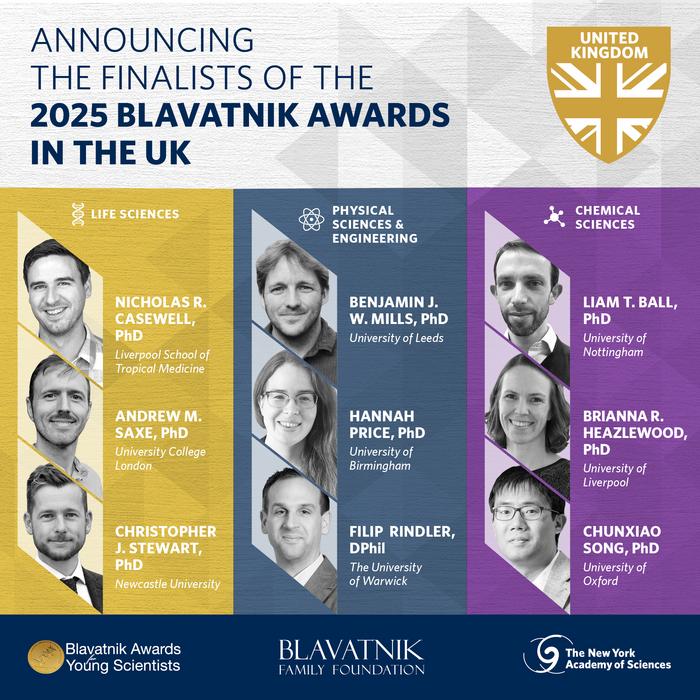
London has delivered great news, sharing the finalists for the highly regarded 2025 UK Blavatnik Awards for Young Scientists, granted by the Blavatnik Family Foundation and in partnership with The New York Academy of Sciences. Announced on 19 February 2025, it showcases the Foundation's commitment to recognizing outstanding contributions made by young researchers in varied fields of science including Life Sciences, Chemical Sciences, and Physical Sciences & Engineering. It will end with a wonderful gala dinner on 4 March, celebrating three laureates for their outstanding research work and providing an unrestricted prize of £100,000 to each, marking an incredible opportunity for early-career scientists.
This year's finalists underwent a rigorous and highly competitive selection process. An independent panel of distinguished scientists reviewed 94 nominees from 45 respectable academic and research institutions across the UK, reflected the vast pool of talent within the scientific community. Those who made it through to the finals have been acknowledged for their groundbreaking contributions that question current holdings in science and bear the potential to make notable advancements in their areas.
The finalists in this category provide a reminder of the importance of applied research in addressing pressing health challenges. Nicholas R. Casewell, a toxinologist from the Liverpool School of Tropical Medicine, is one such finalist who spearheads work on new molecular approaches to deciphering the intricate web of snake venom toxins. Through this research, he hopes to develop novel therapies for snakebite envenoming syndrome, a condition that afflicts vulnerable populations in many tropical regions and which typically leads to severe morbidity and mortality. His work therefore underscores the vital connectivity that exists between molecular biology and public health, in fact, this type of research is critically important given today’s global health circumstances.
Another major finalist is Andrew M. Saxe, a neuroscientist from University College London. His groundbreaking mathematical analysis has uncovered important learning mechanisms that are equally pertinent to biological systems as well as to artificial intelligence. His findings advance knowledge of memory and neurological disorders and help a promising field—AI—that has much potential for future tech innovations. The results of this work go beyond just theory, having real-world impact on making smarter machines and enhancing cognitive therapy techniques.
A Newcastle University student and finalist, Christopher Stewart, has started to carve out a niche for himself in Life Sciences. His pioneering research is based on the microbiome, and he has developed new microbiome-based approaches for necrotising enterocolitis (NEC). This severe disease, mainly affecting premature infants, is a significant death toll risk worldwide. By directing negligence towards one of the main causes of death in this specially targeted group, his innovative methods stand chances of saving hundreds of lives- a point that underscores how truly important dedicated scientific research can be.
In Chemical Sciences, what we present is a finalist proving outstanding achievement in chemical synthesis and application. Liam T. Ball from the University of Nottingham leads with his work on sustainable routes to healthcare and agricultural chemicals. This endeavor seems to ensure safe and effective synthetic methodologies as an increasing awareness of the environmental impact of chemical manufacturing combines innovation with ecological mindfulness.
Brianna R. Heazlewood, a physical chemist at the University of Liverpool, is further enhancing our understanding of complex chemical reactions taking place at very low temperatures. In turn, her work illuminates the chemistry of space- notoriously difficult, with important implications for both astronomy and materials science. She uncovers fundamental mechanisms that control chemical behavior, providing basic research insights to help us understand more about cosmic events.
Chunxiao Song, from the University of Oxford, has been recognized for major contributions to chemical biology. She is developing enhanced sequencing methodologies to precisely detect alterations in DNA and RNA. Her groundbreaking work enables earlier cancer detection and progresses cancer research while also leading to the establishment of a successful biotech firm focused on these new methods—an entrepreneurial spirit that should be emulated in scientific progress.
In Earth Science and Biology, at University of Leeds, Benjamin J.W. Mills is changing how we think about links between Earth's geology and biology. His long timescale models connect key atmospheric processes with geological ones; these help us understand better what has happened in the past while also addressing problems related to ecological sustainability in the future— as well as the question of life elsewhere. His new view creates a connection between Earth sciences and astrobiology, helping us learn more about life on Earth and in space.
Hannah Price, a theoretical physicicist at the University of Birmingham, has been opening new ways of understanding the complexities of higher dimensions with her ground-breaking theories and experiments using synthetic analogues. By simulating situations which represent higher spatial dimensions, her work unlocks fresh avenues for both theoretical physics and practical applications that could change our understanding of the framework and the essential principles of how the universe is constructed.
Filip Rindler of The University of Warwick is proving yet again that mathematics can be innovative- his research has important implications for materials science. By developing a large theory of the way crystalline materials deform through dislocations, Rindler opens a new angle of vision on fundamental mathematics and deepens our understanding of how materials respond to stress. It enriches academic discourse but also holds within it the potential to influence the design of new materials with improved properties.
The Blavatnik Awards have reached a significant milestone with the announcement involving researchers from various institutions: Newcastle University, the University of Liverpool, and the Liverpool School of Tropical Medicine. This year brings greater recognition to early-career scientists in the UK and expands the disciplines touched by this prestigious initiative. Since their inception in 2017, the Blavatnik Awards for Young Scientists have dispensed over £3 million in prize money, marking a note of emphasis on the need to create pathways for young scientists to succeed.
The Blavatnik Awards leave a deep impression on the scientific community. By honoring the successes of young researchers, the awards inspire and encourage future scientists, making an environment ripe for innovation. The prestigious awards granted to our finalists open up unique opportunities for them — opportunities in which these pioneering scientists can pursue research without any restriction, thereby leading to important discoveries with societal benefit and economic impact for the world at large.
On 4 March, people who attend the awards gala will have a chance to see these skilled individuals being honored. Following this, a public symposium, titled "Imagining the Impossible: UK Scientists Changing Our World," is scheduled for 5 March. This event aims to involve the public in conversations about the impactful possibilities of scientific research, underlining young scientists as key players in building a sustainable, innovative future for our planet.
The Blavatnik Awards are part of broader initiatives that underscore the importance of early-career research in various disciplines across the globe. The foundation committed itself to advancing science everywhere because it understood that research done today is the foundation for tomorrow's discoveries. Through the awarding of prizes in different geographies, the Blavatnik initiative fosters international collaboration among scientists, thereby strengthening networks that propel scientific progress.
The development of the Blavatnik Awards proves the importance of nurturing scientific talent. Nearly $20 million in funding by the end of 2025 will help support the creation of new research. This commitment to fostering real scientific advancement both recognizes existing talent and helps nurture the innovators who will tomorrow's discoveries find their way to serving the greater good of humanity.
The 2025 UK Blavatnik Awards for Young Scientists exemplify the curiosity and creativity that combine to power the scientific community. As finalists prepare to present their research, they embody not only their specific disciplines but also the future of science, inspiring others to join the quest for knowledge and discovery.
Mathematical applications; organic chemistry; astrochemical studies of the interstellar medium; cancer research; issues of premature birth; tropical illness; systems neuroscience; earth sciences; and physics